
Physical Influences on Efficiency and Intensity
The characteristics of an infrared lamp are largely determined by physical principles – in particular by the Stefan-Boltzmann law, the emissivity of the material, and the temperature and area of the radiating filament. This article complements the discussion of color temperature and provides more in-depth information on specific emission and the dependence of the lamp's output on material and geometry.
Stefan-Boltzmann Law: Temperature Determines Radiant Power
The specific radiant power of a body – that is, the radiant power emitted per unit area and time – follows the Stefan-Boltzmann Law:
M(T)=ε⋅σ⋅T4
- ε: Emissivity (0–1), dependent on the material
- σ: Stefan-Boltzmann constant
- T: Absolute temperature in Kelvin
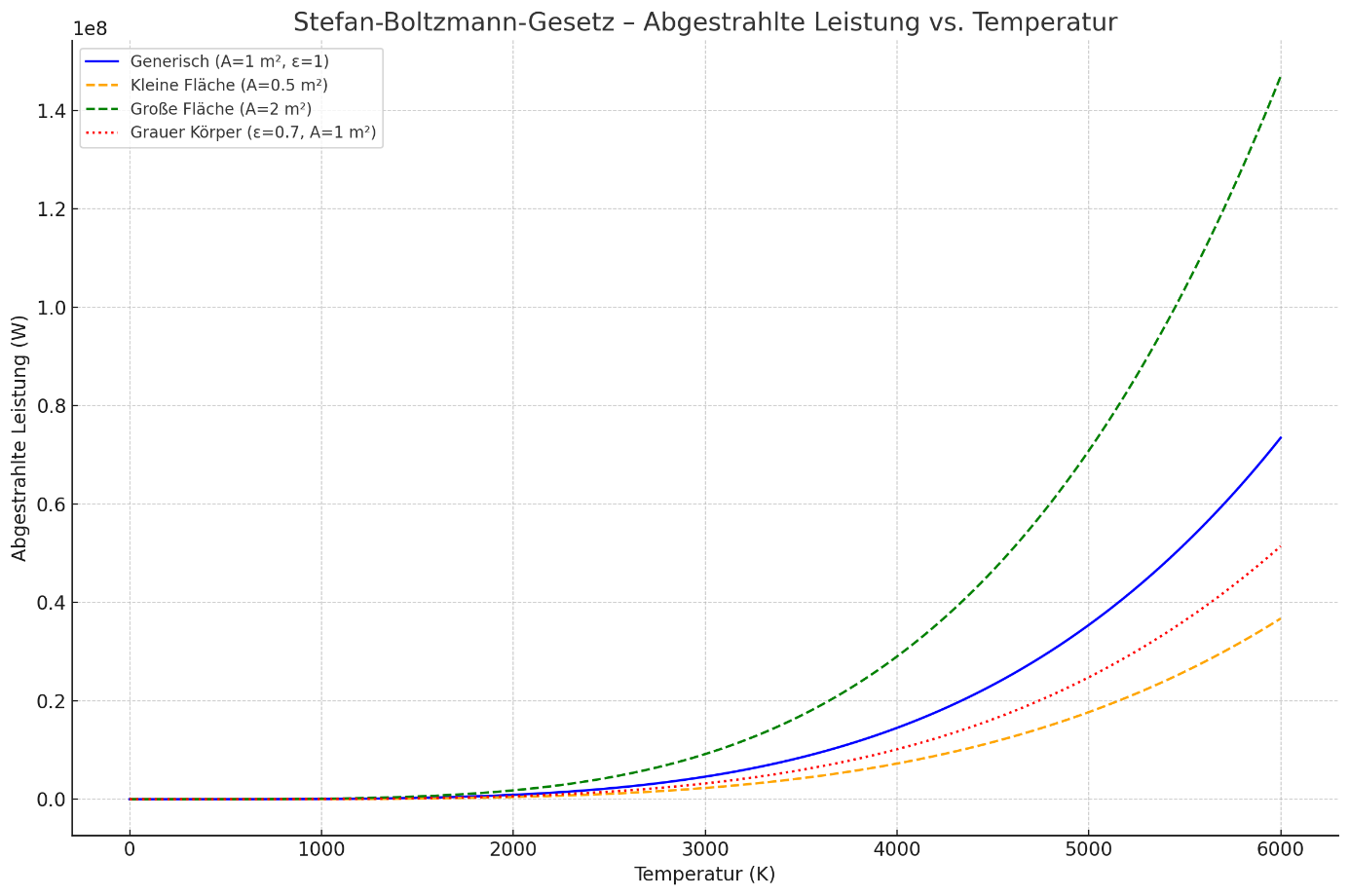
This means: The emitted power increases with the fourth power of the temperature. A doubling of the filament temperature therefore leads to a 16 times higher radiant power per unit area – with the same emissivity.
Color Temperature and Total Power
Why “Colder” Emitters Are Less Efficient
Infrared lamps with a low color temperature (e.g. long-wave IR emitters) have correspondingly lower filament temperatures (approx. 500–1000°C). Due to the T4 dependency, this results in a comparatively low specific emission.
Example:
- A NIR emitter with a filament temperature of 2500K emits significantly more energy per cm² than an FIR emitter with 900K.
- The total output of an infrared lamp is therefore strongly temperature-dependent.
Coil Size
More Surface Area, more Total Output
Since the specific emission is limited at low temperatures, the total radiant output of a lamp can only be compensated for by a larger emitting surface:
P=M(T)⋅A
- P: Total radiated power
- A: Effective filament surface area
Larger filament = higher total power – this is particularly important for long-wave (low-temperature) radiators such as ceramic or carbon radiators.
Emissivity
Material Comparison – Carbon vs. Tungsten
Emissivity ε describes how efficiently a material emits radiation. An ideal blackbody would have ε=1. Real materials have values below this:
- Carbon coil: ε ≈ 0.85–0.95
- Tungsten coil: ε ≈ 0.3–0.4
Therefore: Carbon emitters are significantly more efficient at the same temperature in terms of radiation output than tungsten emitters. Therefore, carbon IR emitters are preferred in applications where high area power at moderate temperatures is desired.
Possible Radiation Output
Limitations due to Temperature and Material Selection
The maximum achievable output of an infrared lamp results from the interplay of the following parameters:
- Coil temperature – limited by material limitations (e.g., melting point, oxidation behavior)
- Coil surface area – determines the total radiating surface area
- Emissivity – directly influences the radiation intensity
- Operating environment – e.g., vacuum, inert gas, or air (cooling, oxidation)
A well-designed IR emitter is therefore a precisely coordinated combination of geometry, material, and temperature range.
Conclusion: Physics Determines the Efficiency of every IR Lamp
Specific emission is not a technical quantity that can be increased arbitrarily – it follows the laws of thermodynamics. Only with a sound understanding of temperature behavior, emissivity, and material physics can high-performance infrared emitters be developed for diverse applications. Radium Tech utilizes this expertise to develop energy-efficient IR systems, individually tailored to industrial requirements.
Learn More
Contact us for a consultation! Our experts from Radium TECH Application Center are available to assist you with your development projects.